
Clean beauty explained: benefits, truths, and myths
TL;DR:
- ‘Clean beauty’ lacks a legal US definition, making brand claims vary widely.
- Effectiveness depends on specific ingredients, not the ‘clean’ label itself.
- Consumers should prioritize transparency, third-party certification, and proven actives when shopping.
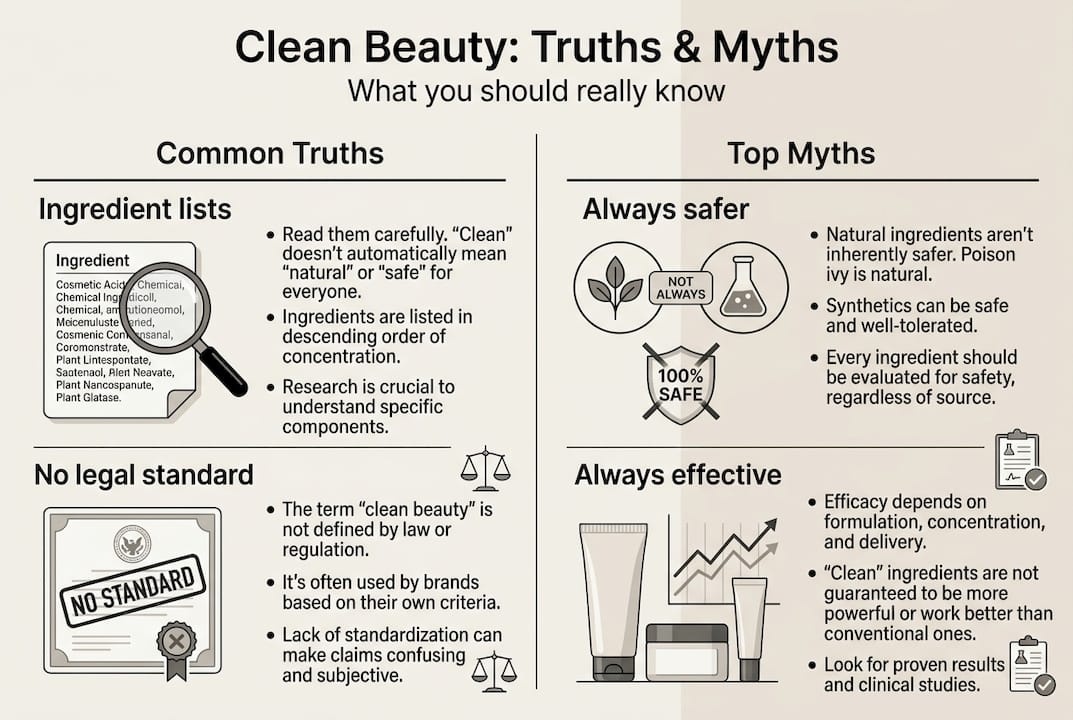
The clean beauty industry is booming, yet the term itself rests on surprisingly shaky ground. Walk into any luxury retailer or scroll through a premium beauty site, and you’ll find ‘clean’ splashed across packaging like a gold seal of approval. But no legal definition exists for it in the United States, meaning any brand can use the word however it likes. That gap between marketing and reality can cost you real money and real results. This guide breaks down what clean beauty actually means, what science says about its effectiveness, and how to shop it with the discernment it deserves.
Table of Contents
- What does ‘clean beauty’ really mean?
- How do brands define and enforce clean beauty?
- Does clean beauty really work? What science shows
- Should you invest in clean beauty? Smart luxury choices
- The clean beauty paradox: Our expert take
- Discover your luxury, clean beauty experience
- Frequently asked questions
Key Takeaways
| Point | Details |
|---|---|
| No legal definition | Clean beauty has no legal meaning in the U.S., so standards vary widely among brands. |
| Focus on ingredients | Always check full ingredient lists and seek third-party certifications for luxury clean products. |
| Marketing vs. efficacy | Scientific studies show select clean ingredients are effective, but not all clean beauty claims are proven. |
| Smart luxury choices | Curate your routine by prioritizing transparency, ethical values, and proven results over buzzwords. |
What does ‘clean beauty’ really mean?
To truly understand the value proposition, let’s first dissect the term itself. ‘Clean beauty’ is one of those phrases that feels self-explanatory until you try to pin it down. Is it about natural ingredients? Non-toxic formulas? Sustainable packaging? Cruelty-free testing? The honest answer is: it can mean all of those things, or just one, depending on who’s selling it.
The FDA bans roughly 30 ingredients in cosmetics sold in the United States, while the European Union restricts or bans over 1,300. That’s a staggering gap, and it’s why American consumers can’t assume that a product sold legally here meets the same safety threshold as one sold in Europe. The ‘clean’ label emerged partly as a consumer-driven response to this regulatory vacuum.
“There is no legal or regulatory definition of ‘clean beauty’ in the US. The FDA does not regulate the term, which means brands are free to define it on their own terms.” — Healthline
For luxury consumers, this matters because premium price points imply premium standards. But price alone doesn’t guarantee ingredient integrity. What ‘clean beauty’ typically signals, at its best, includes:
- Ingredient transparency: Full disclosure of what’s in the formula, with no hidden or vague terms like ‘fragrance’ masking dozens of chemicals
- Ethical sourcing: Ingredients obtained without exploiting communities or ecosystems
- Cruelty-free practices: No animal testing at any stage of production
- Selective ingredient exclusions: Avoiding specific compounds like parabens, sulfates, or synthetic dyes that some research flags as potentially problematic
- Environmental consideration: Packaging and production choices that reduce ecological impact
For shoppers who invest in beauty products that reflect their values, understanding these pillars is the first step to spending wisely. ‘Clean’ can be a meaningful commitment or a marketing shortcut. Knowing the difference puts you in control.
How do brands define and enforce clean beauty?
Now that we’ve clarified what ‘clean beauty’ means, how are these standards actually set and maintained? The short answer: brands and retailers set their own rules, and those rules vary widely.
Major retailers self-define clean standards through proprietary exclusion lists, and coalitions like the Know Beauty Data Base (KBDB) push for more transparency. But even these coalitions face criticism for focusing on hazard-based exclusions without requiring brands to prove their formulas actually perform. The Modernization of Cosmetics Regulation Act (MoCRA) added some FDA oversight in 2023, but it still doesn’t define or regulate ‘clean.’
Here’s how some major players compare:
| Retailer / Standard | Ingredients excluded | Third-party verified | Cruelty-free required |
|---|---|---|---|
| Sephora Clean | 50+ | No | No |
| Ulta Conscious Beauty | Varies by tier | Partial | Optional |
| EU Cosmetics Regulation | 1,300+ | Yes (by law) | Yes |
| Small luxury brands | Self-defined | Sometimes | Often |
This table makes one thing clear: ‘clean’ is not a single standard. It’s a spectrum. For luxury shoppers who expect precision, that ambiguity is worth taking seriously.
Here’s how to interpret brand claims effectively:
- Read the full ingredient list. Don’t rely on front-of-pack claims alone.
- Look for third-party certifications like EWG Verified, COSMOS Organic, or Leaping Bunny.
- Research the brand’s exclusion list. A longer list isn’t always better, but transparency is.
- Check for MoCRA compliance as a baseline for safety documentation.
Pro Tip: When shopping for tools like contour brushes or skincare like African black soap, prioritize brands that publish their full ingredient lists and hold recognized third-party certifications. That combination is the most meaningful signal of genuine clean credentials.
Does clean beauty really work? What science shows
After understanding the standards, let’s examine if ‘clean beauty’ delivers on its efficacy and safety promises. This is where things get nuanced, and where smart shoppers separate fact from feeling.

Here’s the uncomfortable truth: no large-scale evidence proves that clean beauty products are categorically safer or more effective than conventional ones. The ‘clean’ label itself is not a performance metric. What does show promise is research on specific ingredients commonly found in clean formulations.
| Ingredient | Studied benefit | Effect noted |
|---|---|---|
| Niacinamide | Sebum regulation | Up to 21% reduction |
| Bakuchiol | Wrinkle improvement | Comparable to retinol |
| Rosehip oil | Hydration and tone | Significant improvement |
| Green tea extract | Antioxidant protection | Reduces oxidative stress |
A 21% reduction in sebum production has been documented for certain plant-based actives in clean formulations, which is genuinely impressive for oily or combination skin types.
“Evidence on the efficacy of clean beauty as a category is limited. Benefits observed in studies are typically tied to specific ingredients, not the ‘clean’ designation itself.” — Cosmetics (MDPI, 2026)
For luxury consumers, this reframes the conversation. You’re not buying ‘cleanness.’ You’re buying a curated selection of ingredients that, when chosen well, can deliver real results. Products like tinted moisturizers with Moroccan oil represent this approach: evidence-backed actives in an ethically formulated base. The experience, the texture, the brand philosophy all add to the perceived value. But the results come from the ingredients.
Should you invest in clean beauty? Smart luxury choices
Equipped with the facts, let’s get practical about building a luxury clean beauty ritual. The goal isn’t to become a cosmetic chemist. It’s to shop with enough knowledge that you’re never misled by a label.
When evaluating a premium clean beauty product, look for:
- Third-party certification: EWG Verified, COSMOS, or Leaping Bunny logos carry real weight
- Full ingredient disclosure: Every ingredient listed, including preservatives and fragrance components
- Cruelty-free confirmation: Look for official certification, not just a claim
- Ethical sourcing statements: Specific, not vague. “Sustainably harvested from X region” beats “responsibly sourced”
- Proven actives: Ingredients with published research behind them, not just trend appeal
Here’s a practical approach to curating your clean luxury routine:
- Audit your current products. Use EWG’s Skin Deep database to check what you’re already using.
- Prioritize leave-on products first. Serums, moisturizers, and foundations have more skin contact time than rinse-off products.
- Replace one product at a time. This lets you track what’s working and what isn’t.
- Choose multi-use formulas. A clean tinted moisturizer or a versatile mink lash that works for multiple looks reduces your overall product load.
- Cleanse with intention. A detoxifying charcoal cleanser is a strong starting point for any clean routine.
Pro Tip: Don’t equate ‘natural’ with safer or more effective. Poison ivy is natural. What matters is whether an ingredient has been studied, at what concentration it’s used, and whether the brand is transparent about its formulation choices. Brands self-defining their own standards means you need to do a small amount of homework. It’s worth it.
The clean beauty paradox: Our expert take
Let’s step back and challenge some assumptions with an industry-insider perspective. Here’s what years of working with premium beauty products has taught us: the ‘clean beauty’ label is simultaneously one of the most powerful tools consumers have and one of the most easily abused.
When savvy, values-driven shoppers demand clean formulas, brands respond. That’s real market pressure producing real change. More transparency, better sourcing, stricter self-regulation. The consumer is genuinely driving the industry forward.
But here’s the paradox. The very lack of regulation that makes ‘clean’ meaningful as a consumer movement also makes it easy to exploit. We’ve seen beautifully packaged products with vague exclusion lists command luxury prices without delivering luxury results.
What actually matters isn’t the label. It’s ingredient transparency, a brand’s documented values, and your own beauty philosophy. When you know what you’re looking for, no marketing claim can mislead you. That’s the real power of understanding clean beauty: not blind trust, but informed confidence.
Discover your luxury, clean beauty experience
If you’re ready to experience clean beauty with confidence, here’s where to start. At Luxe Life Cosmetics, every product in our curated collection reflects a commitment to ethical sourcing, ingredient transparency, and results that go beyond trends.
From the deeply nourishing African black soap to the show-stopping drama of Melanie mink lashes, our selection is built for beauty enthusiasts who refuse to compromise on quality or conscience. At Luxe Life Cosmetics, clean beauty isn’t a marketing phrase. It’s a standard we hold ourselves to every time we add a product to our shelves. Explore the collection and shop with the assurance that every choice you make here is one you can feel genuinely good about.
Frequently asked questions
Is clean beauty always vegan and cruelty-free?
Not always. ‘Clean’ typically refers to ingredient choices, while vegan and cruelty-free are separate certifications that a product must explicitly carry to be verified.
How can I tell if a clean beauty product is truly safer?
Look for third-party certifications and a full ingredient list, and cross-reference key ingredients with current research, since no blanket proof exists that clean beauty is universally safer than conventional alternatives.
Does clean beauty cost more than traditional alternatives?
Generally yes. Premium clean products reflect the cost of ethical sourcing, small-batch production, and higher-grade ingredients, all of which contribute to a more considered formulation and a higher price point.
Are clean beauty brands regulated by the FDA?
The FDA does not regulate or define ‘clean beauty’ as a term, though all cosmetics sold in the US must still comply with general safety and labeling laws under MoCRA.
Can clean beauty products be effective for luxury skincare needs?
Yes, many can, but effectiveness comes from specific studied ingredients rather than the ‘clean’ label itself, so always evaluate the formulation rather than the marketing claim.